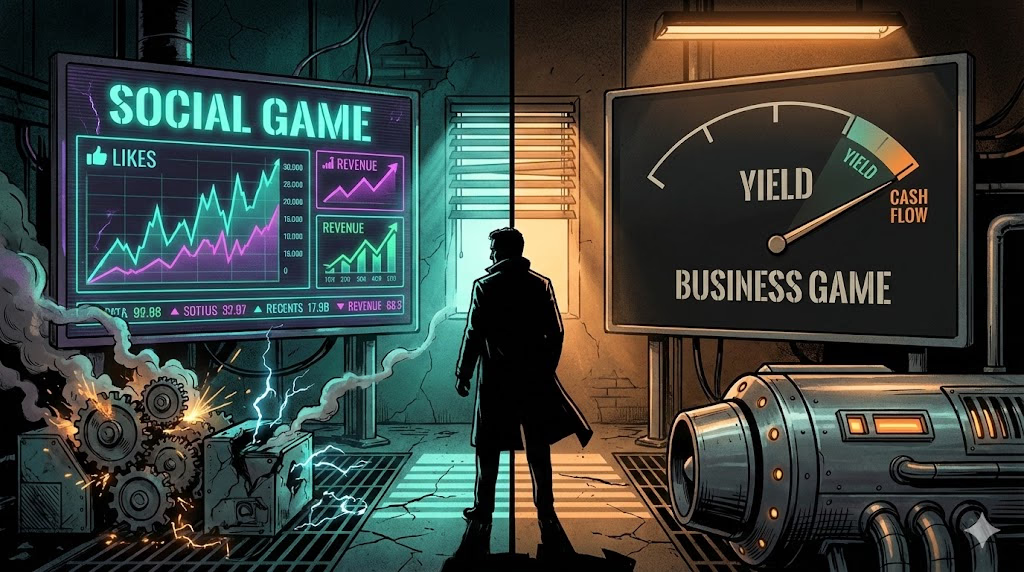
When I took over the family business, I thought I was playing a business game. I was actually playing a vanity game. Grow revenue. Hire headcount. Look big. That approach works for VC-funded companies where losses are called investments. For a business that must generate cash every month to meet its own expenses, it is suicide.
The scoreboard for the social game is public i.e. likes, congratulations, and growth charts. The business game is played in the dark. It has completely different rules.
System Definition
Strip away the romance and a business is a machine. The inputs are cash, time, human energy, and stress. The process is value creation. The output is more cash than went in.
That is it. Customer satisfaction is not the output. Disrupting the industry is not the output. Those are the permission slips that allow the machine to keep running. The only valid output of the business game is yield.
The Siege
In 2021, I hit a wall. One customer controlled roughly 25% of our revenue. We were billing them Rs 48 lakhs per month. On paper, the revenue looked strong. In reality, I was bleeding.
The client had slowly changed the terms. The credit period stretched from 30 to 45 days. My working capital locked up jumped from Rs 45 lakhs to roughly Rs 75 lakhs. Service fees got squeezed until net return on capital employed fell to about 7%. Walking away meant shrinking the company by 25% overnight, barely a year after I took charge.
So I removed emotion and looked at the numbers. The math was embarrassing.
Three Axioms of the Business Game
I decided to exit the Rs 5.76 crore contract. Looking back, I realised I was not just fixing a margin problem. I was realigning with three basic rules I had violated.
The first is that customer satisfaction is a constraint, not a goal. In the social game, the customer is king. In the business game, the customer is a variable. You need happy customers to keep playing, but if making them happy costs more than the cash they return, you are failing the system. You do not exist to serve customers. You serve customers to exist. If a customer demands 60-day payment terms and round-the-clock stress while returning less than the cost of that attention, that customer is a defect in the machine, not a feature.
The second is that the benchmark is the Nifty, not your competitor. In the social game, you compete against other founders. In the business game, you compete against passive capital. If your business generates a 12% return on capital but consumes 60 hours of your week and every bit of your mental energy, you are losing to a boring index fund that generates the same 12% with zero effort. If the work you put in does not generate excess return over the Nifty, you are not an entrepreneur. You are an inefficient asset manager.
The third is that volume is vanity, velocity is sanity. The social game loves volume — we manage 5,000 people, we have offices in ten cities. The business game measures how fast one rupee leaves and returns as Rs 1.20. I used to take pride in managing large teams. Now I understand that managing people is the cost of doing business, not the badge. The best business generates the maximum output with the minimum number of people and the minimum amount of capital.
The Test
If you are stressed but growing, you are winning the social game and losing the business game. The social game pays in recognition. The business game pays in freedom.
Two questions cut through the noise. First, the Nifty test: if you invested the capital required to service this client into the Nifty 50, would you earn more with less stress? Second, the 15% rule: does this contract clear 15% net return after all overheads: cash, time, and attention?
If the answer to either is no, you are not growing. You are financing someone else’s operation.