For all of 2023 and 2024, I played a game of security theatre with AI.
I had built a small repository of notes — observations, insights, and market data accumulated over years. As AI models improved, I refused to add this context to the conversation window. My fear was specific: I do not want my hard-earned thinking to train the model.
I treated my notes like gold bars. I thought withholding them gave me an edge. In 2025, I realised I was wrong. I was not protecting anything. I was just starving the system.
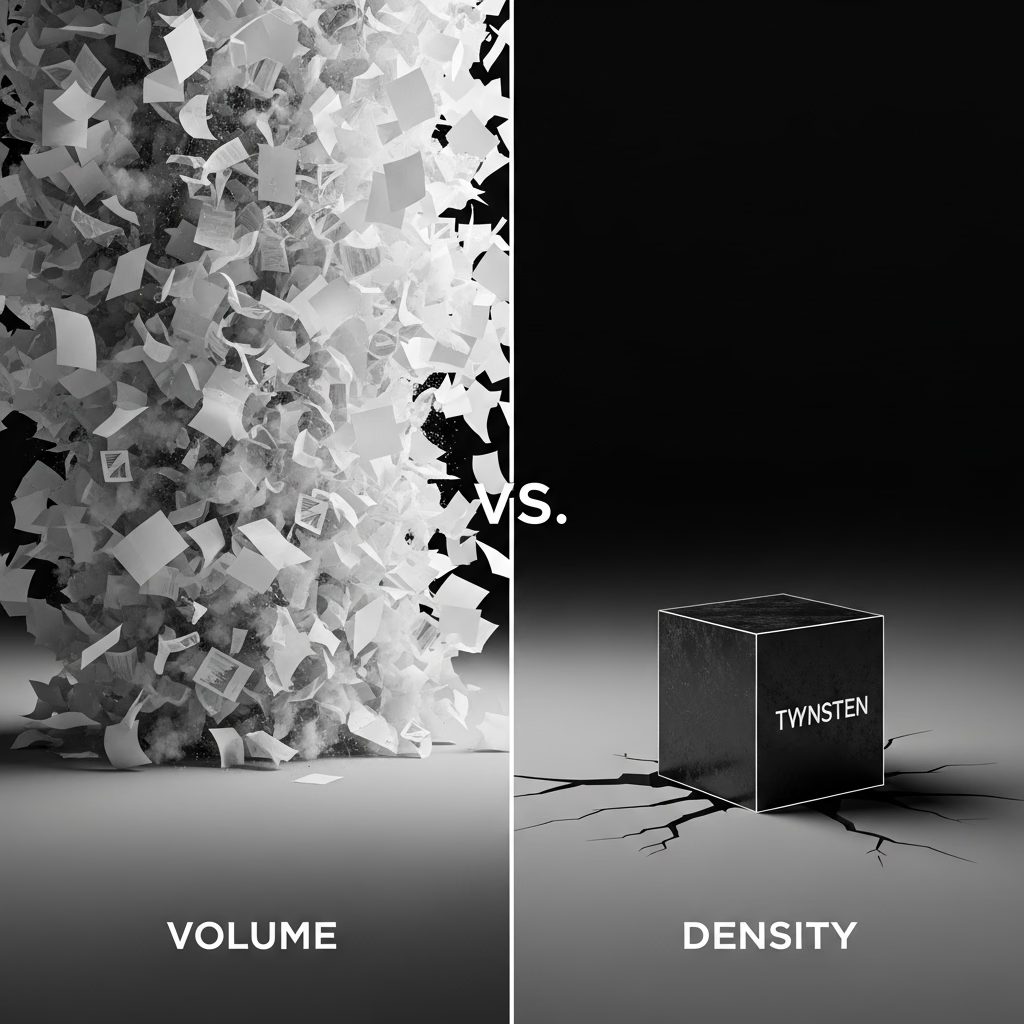
The Realization: Volume vs Density
The shift happened when I stopped thinking about privacy and started thinking about physics.
My notes were raw data — what I now call volume. In the age of AI, volume is free. No matter how unique I think my observations are, the archetypes of my thinking are mostly public. The AI already has access to the sum of public knowledge. The models simulate the mean of all human output. What they lack is density — the specific, high-pressure judgment of my operational reality.
If I hide my context, the output is generic. If I feed the model specific context about my situation, the output carries the density of my actual judgment. The mental effort of sanitising every prompt to protect ideas was not security. It was friction. So I let go. The results did not just get faster. They got materially better.
The Open Source Parallel
This is not a new phenomenon. It is the history of software.
We depend on open-source foundations: Linux, TensorFlow, ImageNet. These tools were shared, not hidden. Because they were open, millions of people built on top of them, developed faster, and became more productive.
The lesson from open source is that credit belongs to the idea, but commercial value belongs to the workflow built on top of it. You can build a profitable business on open intelligence. The value is not in hoarding the notes. The value is in the process you construct on top of them.
The Operational Reality
I run a small business — a tight-knot operation. When a sudden research need hits, like a compliance change or a competitor audit, I have no bench of analysts to deploy. Every information task used to demand my direct attention. I was manually generating volume.
Now, with tools like NotebookLM and deep research, that layer is gone. I engage with the material, not the search bar.
The Density Doctrine
Outsourcing everything to AI carries its own risk. I would lose the judgment that makes the output worth anything. So I place strict constraints on where the boundary sits.
AI owns volume — the expansion. I delegate everything that requires covering ground: finding documents, summarising threads, formatting tables, scanning for contradictions. If a task involves gathering or sorting, I do not touch it. That is a machine task.
I own density — the compression. I never ask AI what I should write or what I should decide. I share the topic, my insights, and the constraints. The machine builds the walls; I draw the blueprint. My job is to compress the volume into a decision.
I also use AI as a sparring partner. My most common prompt is: act as a Socratic partner and ask me three questions to dig deeper into this premise. I tell it explicitly to play devil’s advocate. If I am in an echo chamber, I have already lost.
The one hard boundary: I never feed confidential client data into any model. Strategy, insights, notes, frameworks — I share these without hesitation. Client personal data, identification information, financials — these never touch the model. Privacy is for people. It is not for ideas.
The Flywheel Effect
Since I stopped withholding my context, the AI has not stolen my ideas. It has forced me to develop better ones. By offloading the memory work and the search work, I freed up mental capacity to actually judge the material. I am no longer tired from finding the information. I have the energy to evaluate it.
Withholding my own thinking was not safety. It was friction with a more flattering name.
Newton’s Third Law
We often treat AI like a vending machine: insert prompt, receive answer. That is the wrong physics. The interaction runs on Newton’s third law — for every action, an equal and opposite reaction.
The force you put in — the depth of your context, the sharpness of your constraints, the honesty of your data — determines the force that comes back. Feed it hesitation and you get hallucination. Feed it generic prompts and you get the average of the internet. Feed it the hard, specific reality of your constraints and you get something genuinely useful.
Withholding your context does not keep you safe. It just gives you worse output.