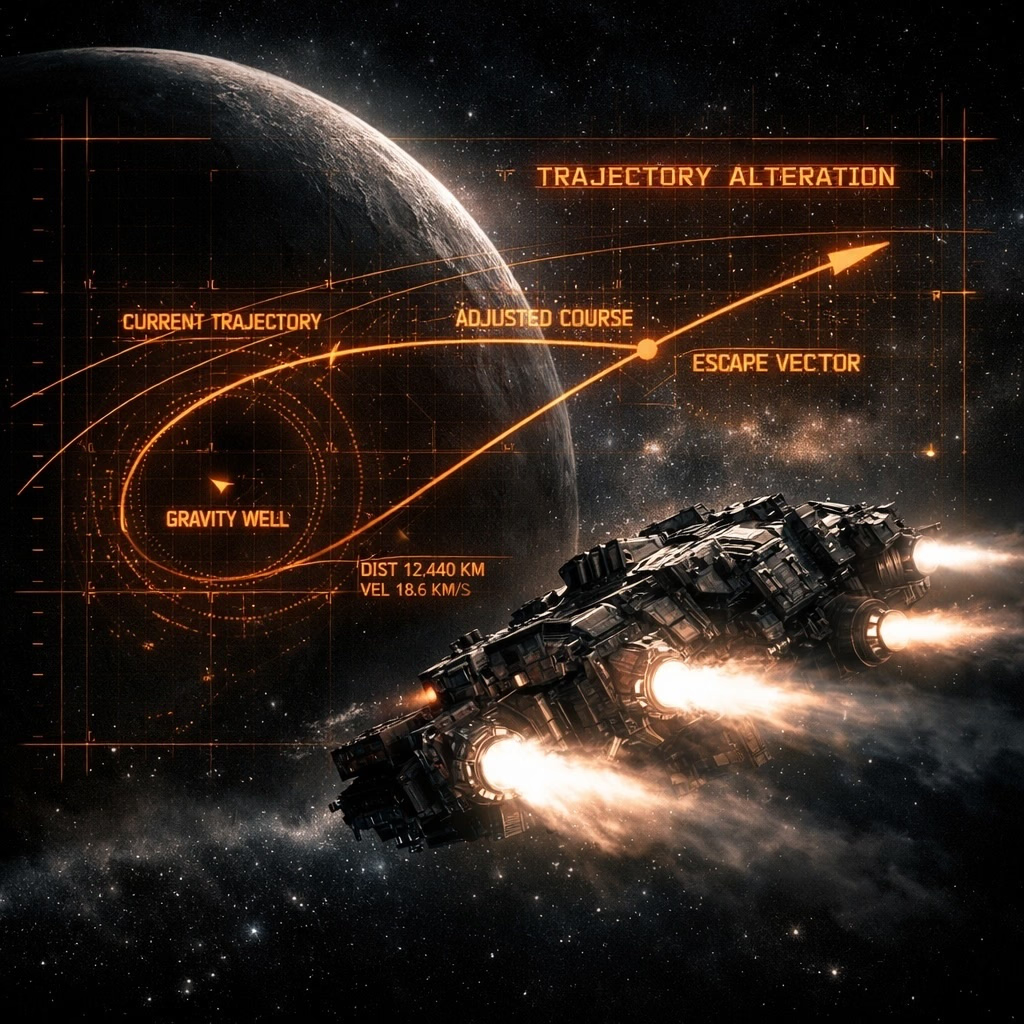
A pivot is not a failure. In orbital mechanics, it is a thruster burn.
When a spacecraft is on a decaying trajectory, staying the course is not persistence. It is suicide. To survive, you must fire the thrusters early enough to change the vector — before you run out of fuel.
Most founders do not crash because they lack skill. They crash because they confuse motion with progress. They get trapped by Founder’s Gravity: the inertia created by sunk cost, public commitment, and ego. The most dangerous sentence in business is: the model works, the market just needs time. That sentence has killed more businesses than bad maths ever did. I know, because it almost killed mine.
The CCTV Business That Looked Rational
Two years ago, I explored building a CCTV-as-a-Service business. It started with a real anchor customer: 500-plus cameras, a three-year contract, and end-to-end responsibility.
The numbers looked clean. Capital funded at roughly 10% via overdraft. Contract internal rate of return at approximately 18%. Net return at roughly 14% per year. It appeared to be a logical extension of my existing business. I spent three months on it. I spent about Rs 2 lakhs on travel, supplier meetings, and bank structuring.
The offer was solid: a monthly rental model, 24-hour free replacement, high-reliability hardware. Everyone I spoke to said the same thing — this makes sense.
After 40-plus meetings across 30 companies, not a single new order was placed.
The Physics of Indifference
I had assumed buyers cared whether CCTV worked around the clock. They did not. They cared that CCTV existed — for compliance, insurance, or standard operating procedures. If footage failed, nobody lost sleep. If cameras were cheap, procurement was satisfied. If something broke, it got ignored.
I was not competing on value. I was competing against indifference. And indifference is undefeated. I was solving a problem that caused no pain.
Painkiller vs Vitamin
This distinction is often described loosely, so I want to be precise. It is not about importance. It is about behaviour under pressure.
A vitamin addresses a problem people agree exists but do not act on. Decisions float upward. No single person owns the failure. Fixing the problem earns no credit; ignoring it carries no cost. My CCTV business lived here.
A painkiller solves a problem that is already extracting a visible tax. Someone is losing money, time, or sleep. Someone is personally exposed if it fails. Someone has already built an ugly workaround to cope with it. That last point is the tell.
The Hack Signal
Here is the law I missed: if the buyer is not already hacking around the problem, they will not pay you to solve it.
A hack is evidence of pain. It is the smoke that proves the fire. Look for manual spreadsheets held together by one stressed employee. Look for WhatsApp groups active at 10 PM. Look for personal calls to “that person who fixes it.” Look for overtime wages paid just to keep things running. If there is no hack, there is no urgency. If there is no urgency, there is no buyer.
By the time this signal becomes obvious, founders are already trapped. They have invested money, time, reputation, and identity. So they interpret the indifference as an early market problem, an education problem, or a long sales cycle. That is not analysis. That is gravity talking.
The Kill Protocol
You have limited delta-V — the ability to change direction. Your fuel tanks, which are cash and morale, are finite. You cannot orbit a bad idea forever.
Run this diagnostic. First, the hack audit: can you point to a specific, ugly, expensive workaround your target customer is already using? If yes, proceed. If no, you are selling a vitamin.
Second, the death clock: set the rule before emotions kick in. If after 25-plus conversations with at least ten people who control the budget, you cannot observe a workaround that is costing them money or time, the idea is dead. No extensions. No reinterpretation.
Third, the burn: if the data says no, do not iterate. Pivot only if the customer changes, the problem changes, or the solution changes. Some ideas do not deserve a pivot. They deserve a burial.
Conclusion
As I wrote in a previous post: opportunity is not intent. Opportunity is committed energy already at risk.
This essay addresses what happens after energy exists but is pointed in the wrong direction.
You do not die because you lacked effort. You die because you mistook indifference for traction and called it patience.
If you cannot find a trajectory that intersects real pain, there is only one rational move left: land the ship, save the crew, and live to launch again.