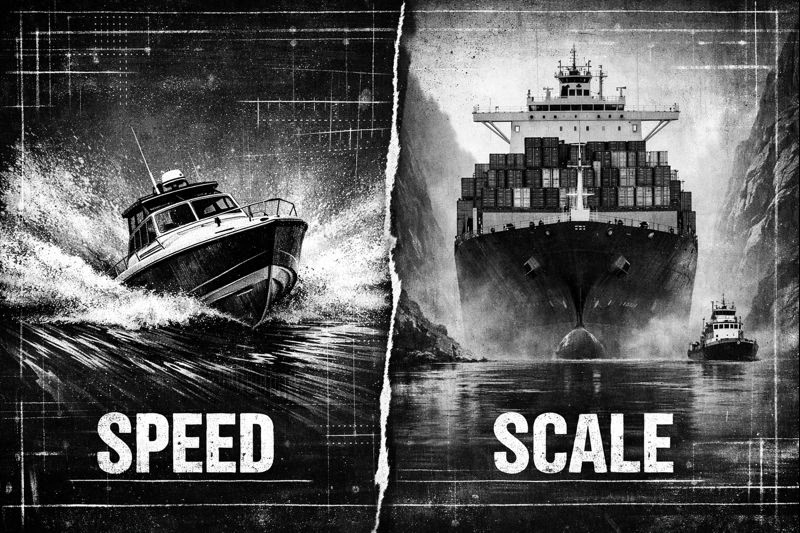
At Rs 2L a month, I made every decision myself. At Rs 10L a month, I could not get anyone to listen to me. The business had not gotten worse. The physics had changed.
I learned this not in my current business but during my time on the TaxiForSure expansion team.
I had just finished launching Vadodara and Rajkot. Those were speedboat operations. I was the sole decision-maker. If I wanted to change a driver incentive, I changed it. If I needed to revise a marketing plan, I did it over lunch. Mistakes happened, but they were cheap and I could reverse course immediately.
Then came Punjab.
The Scale Tax
This was not a single city launch. I was tasked with launching Chandigarh, Amritsar, Jalandhar, and Ludhiana within four months — hiring local teams, setting up infrastructure, onboarding cabs, and hitting 100 to 250 daily transactions within two weeks of each launch.
I was not solo anymore. I had a team of five, most of them on their first expansion. I was not just launching cities. I was getting three people ready to launch their own cities while coordinating with HQ and a regional office.
That is when the scale tax hit.
In Vadodara, the distance between problem and solution was zero. In Punjab, that distance was filled with stakeholders.
The specific friction point was driver incentives. As the business scaled, a corporate supply team was set up and rolled out a wartime incentive plan — a Rs 60,000 monthly business guarantee to fight Ola and Uber. The model relied on heavy cash burn to buy speed.
I had reservations. High guarantees build bad habits. Drivers log in for the assurance, not the work. I wanted a different model for Chandigarh: cap the guarantee at Rs 45,000 and add a weekly performance-based incentive. This limited the burn rate while letting the better drivers earn more.
The logic was correct. It did not matter.
The Logic Trap
I sent spreadsheets. I wrote detailed emails modelling the expected driver behaviour. I explained the Rs 15,000 per-driver-per-month difference in burn rate across a fleet of 200 drivers.
The response from the central supply team was silence, then pushback about standardisation. Their KPI was growth at any expense. My model added complexity. Their model added speed, at a cost.
I was stuck in what I now call the competency trap. I was arguing operational logic with people who had no exposure to operational downside. This is the hidden failure mode at scale: decisions made by people insulated from consequences.
Logic does not win arguments at that altitude. Jurisdiction does.
The P&L Shield
I stopped arguing with the central supply team. I went to the Punjab state head instead.
Unlike the functional teams, he was not measured on standardisation. He was measured on the regional P&L. Once operations launched, the burn was his problem. If the incentive model was too expensive, it was his neck.
I spent three days rebuilding the model. Scenario A was the HQ plan: we hit the transaction targets, but monthly burn across four cities is at the full Rs 60,000 guarantee level. Scenario B was my plan: we hit the same targets, burn is lower by Rs 15,000 per driver per month, and fleet retention is higher because top performers earn more.
I did not give him better logic. I gave him survival math.
The Override
The state head did not care about standardisation. He cared about his margin. He took my model and used his rank to override the central supply team. He did not ask for permission. He made a P&L decision.
We launched Chandigarh with the Rs 45,000 cap.
The launch succeeded. I also recognised that what worked in Chandigarh was not automatic elsewhere. We used the central team model in Ludhiana, where the driver market dynamics were different. We ran the Chandigarh model in Jalandhar and Amritsar. We hit transaction targets across all four cities. More importantly, the local teams had enough room to adapt the model to their own conditions.
What This Taught Me
The hidden law of scaling is simple. At small scale, speed beats structure. At large scale, authority beats correctness.
Operations feel heavier at Rs 10L than at Rs 2L not because people get dumber, but because decision rights migrate upward. The people with operational knowledge lose jurisdiction. The people with jurisdiction lack operational context. And logic alone cannot bridge that gap.
If you are stuck fighting a decision that makes no operational sense, stop trying to convince functional stakeholders with operational details. They do not have the jurisdiction to care about your numbers. They have their own KPIs and their own insulation from downside.
Find the person holding the downside. Show them the survival math. That is the only argument that lands.
The question worth asking this week: whose P&L are you actually talking to?