Momentum equals mass multiplied by velocity. Speed never appears in the equation. Most of us treat the two as synonyms. They are not.
Speed is a scalar quantity. It measures how fast you are moving — we shipped four features this week. Velocity is a vector quantity. It measures how fast you are moving toward a specific point. Speed is effort. Velocity is displacement. If you run at 100 miles per hour toward a cliff, your speed is high but your velocity relative to safety is negative.
I learned this difference the hard way, not in a boardroom, but on the apron of an airport construction site.
The Concrete Trap
Years before I built systems, I worked on the Delhi T3 project at L&T. My team was responsible for constructing the apron — the parking area for aircraft. The structure has three layers. First, a fully compacted ground layer. Then CTB, cement treated base, which transfers heavy load to the ground. Then PQC, pavement quality concrete, which is the visible top surface.
We were measured on one metric: daily cubic metres of PQC poured. Every morning the pressure was simple — how much concrete will you lay today? That was our speed. That was the vanity metric.
Then the rain came.
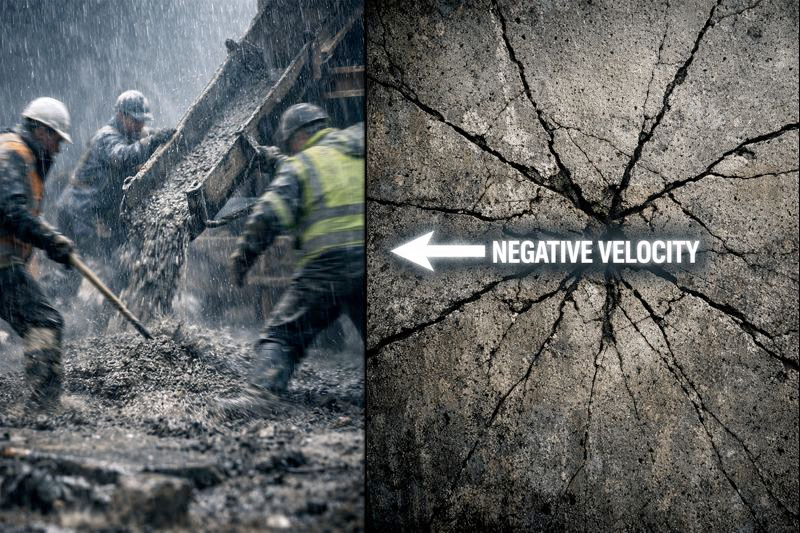
A sudden downpour turned the ground beneath the base layer into sludge. Logic demanded we stop. The ground needed to be re-compacted and dried for 24 hours. Lay heavy base on wet mud and the foundation shifts. But the client’s senior management was visiting in 48 hours. The site had to look active. The instruction from above was blunt: we need to show progress, just pour it, if issues come up we will pay for the repair.
My manager agreed. We prioritised speed over velocity.
We poured the concrete. We hit the target. The VIP saw a busy site. We saved two days.
The Sound of Negative Velocity
Three weeks later, the ground settled. The rigid concrete above it did not. Spiderweb cracks spread across the panels. We did not patch it. We demolished it. Crews tore out multiple panels, dug out the CTB, re-compacted the ground, and poured everything again.
Time saved by ignoring the wet ground: two days. Time lost to demolition and rework: 14 days. Net velocity: minus 12 days. We moved fast and moved backward.
I see the same physics violation in business all the time. A sales team hires five reps before there is a playbook. Three months later, when they cannot close, those reps are let go. That is the Rework Tax. A product team codes features to hit a launch date without a spec. Two weeks later they rewrite the database schema because they missed a constraint. That is also the Rework Tax.
This is why I am building O9X the way I am. In **O9X Build Log 8**, I wrote about using the project brief as a constraint weapon. I spent days writing that document before writing a single line of code. I forced myself to map every operational edge case — labour laws across 45 cities, overtime rules, compliance checks.
To an outsider, that looked slow. I was not shipping. My GitHub commit count was zero. My speed was zero.
But my velocity was at maximum. I was drying the ground. I was making sure that when I finally poured the code, I would not need the jackhammers a month later.
Measure Your Momentum
Stop measuring how fast your team moves. Start measuring the stability of the ground they are building on.
Apply the Soil Compaction Test to your current sprint. Identify the pour — the major commitment you are about to execute, whether that is hiring a manager, building a new module, or signing a 12-month contract. Then check the ground. Do you have the spec? Do you have the customer commitment? If this breaks, what snaps first and who pays for it?
Finally, run the Rework Tax calculation. If this hypothesis turns out to be wrong, what does it cost to fix it? If the repair cost is ten times the cost of waiting 24 hours, stop. Let the ground dry. Real velocity is often invisible until the concrete sets.