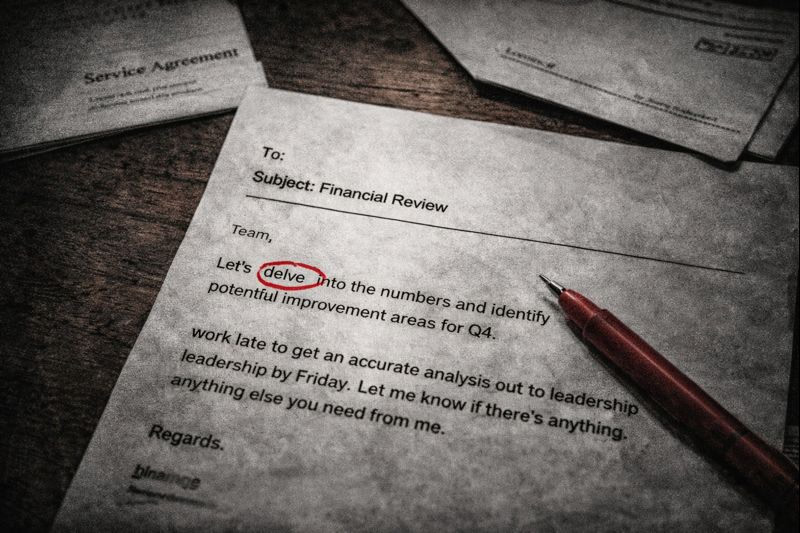
I knew the email was fake when I saw the word “delve.”
A junior HR rep had fed our service contract into ChatGPT, and the AI confidently told him he did not owe me Rs 1.11 Lakhs in arrears. He believed the machine. I called the client’s Ops head immediately.
We talk about AI as a productivity tool. We rarely talk about it as a liability generator. Last year, a free ChatGPT prompt nearly triggered a Labour Department notice carrying a potential Rs 3.33 Lakhs in exposure.
Here is what happened.
The Setup: A Routine Rs 1.11 Lakh Bill
In the manpower business, minimum wage revisions are routine friction. The government updates the rate. We notify the client. They pay the difference.
Last year, one client took five months to revise the pricing on their contract. That delay created arrears — the back pay owed to the security guards for those five months. The calculation was straightforward: 15 guards, Rs 1,850 increase per guard per month, 4 months of delay. Total arrears due: Rs 1.11 Lakhs.
We raised the supplementary invoice. The process is clear. The client confirms and pays, then we disburse the funds to the guards.
The Robot’s Judgment
Then came the rejection email.
It was not a normal pushback. It was polished. It used em dashes. It cited “statutory subsections” of the Minimum Wages Act. In the second paragraph, it used the tell: “We must delve into the contractual obligations…”
I know this client’s Ops Lead. He writes one-line emails from his phone. He does not “delve.”
I called him. “Did you review the email that rejected the arrears invoice?” He was clueless. He said he would check.
Two days later, he called back. They had hired a new junior HR rep to work through a contract backlog. This rep had uploaded our entire service agreement into ChatGPT 3.5 and asked one question: who is responsible for arrears? The AI looked at a generic compliance responsibility clause and produced a confident legal opinion: the contractor pays. It did not stop there. It drafted the rejection letters. The HR rep, trusting the model’s confidence, sent them to five different vendors.
The Rs 3.33 Lakh Risk
In a labour dispute, unpaid wages attract a penalty of up to two times the amount due. The maths: Rs 1.11 Lakhs in arrears, plus Rs 2.22 Lakhs in potential penalty, gives a total dispute value of Rs 3.33 Lakhs.
Technically, the principal employer — the client — is ultimately liable for these payments. Since I had notified them on time, I was not financially on the hook for the penalty.
But that does not save me from the siege.
When a labour violation is flagged, the notice lands on the contractor first. I would not be fighting for money. I would be fighting for time — compiling months of records to prove compliance, spending days at labour court hearings to prove the liability sits with the client.
The bigger risk was not the court. It was the internal audit. A labour notice triggers a trust collapse. The client’s compliance team opens every file, roster, and invoice from the past year. A partnership becomes a policing action. The AI did not just write a bad email. It invited a full compliance investigation into my business.
Compression vs. Judgment
The mistake was not using AI. The mistake was using it for judgment instead of compression.
AI is excellent at compression — turning 50 pages of legal text into a one-page summary. It is unreliable at judgment — deciding who is liable based on that summary. The HR rep used the model to decide. That is the failure mode.
I have already written about why AI is a compression engine, not a decision maker. The distinction is simple. If you use AI to summarise, you save time. If you use it to decide, you import risk.
Monday Morning Audit
Go to your Ops and HR teams this week. Ask one question: are we using AI to write emails that make commitments?
If the answer is yes, pull the last five emails. Look for the polish. Look for the “delve.” If you find it, stop them. Tell them to use AI to draft the options, but a human must type the verdict.
The cost of verifying truth is always lower than the cost of generating a mistake. Do not let a free prompt cost you months of legal headaches.