The Operational Reality
In a constraint-bound business, AI is not a plan. It is a component. Like a junior hire, a script, or a vendor, it comes with a specific failure profile. Most operators get that profile wrong.
The common mistake is treating AI as an agent capable of judgment. We ask it to manage emails, research markets, or decide what matters. But in operations, judgment is an irreversible bet under uncertainty. It carries delayed consequences, second-order effects, and real loss. AI has no exposure to that loss. It optimises for the middle ground, not for consequence. To use AI safely inside messy operations, the boundary must be rigid:
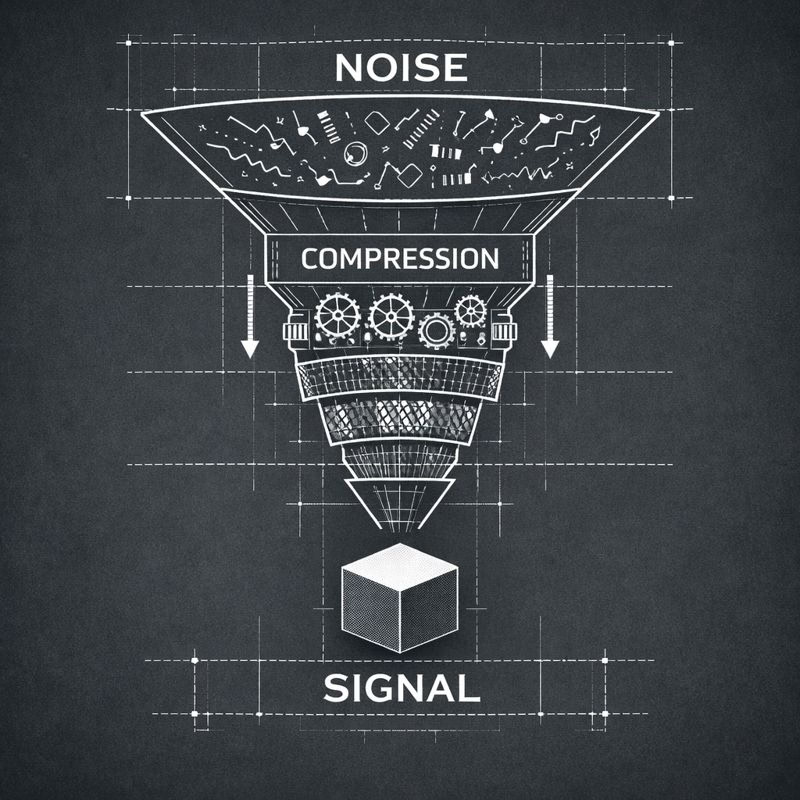
AI gets Compression (Tasks). Humans keep Judgment (Decisions).
The Use Case: The Attention Filter
I faced a real resource problem. Hundreds of hours of interesting YouTube content each week, and not enough time to screen it properly. I needed to know what was worth listening to without spending time I did not have.
The obvious move was to build an agent that would find good content for me. But that would shift judgment to AI, which no matter how capable is not me. I built a compression filter instead.
The system does one job. Input: a YouTube link, raw noise. Process: transcription, then summarisation. Output: structured text for me to read. It watches, it compresses, it stops. It does not decide what matters. It does not recommend action. It does not move pieces on the board. I do.
The Component Evaluation
Every time I bring AI into an operation, I evaluate it against four metrics before committing. For the content filter, the results were straightforward. Reliability was low to medium — the output format is a design choice I can adjust. Cost was zero — API access across multiple tools with no recurring fees. Supervision was zero during execution and 100% during consumption, because I read everything. And the failure mode was contained: if the tool breaks, I lose ten minutes of reading time. I do not lose a client, a contract, or a payroll cycle.
That last metric is the one that matters most.
Why This Works: The Failure Mode Test
This tool works not because it is accurate. It works because the failure is contained. If I asked AI to reply to the emails it summarised, the failure mode would be reputational damage. If I asked it to decide what content mattered, the failure mode would be misdirection. Both are decision risks. By restricting AI to summarisation, the only risk is wasted time. That is a compression risk. Most operators can absorb a compression risk. Almost none can absorb a decision risk.
The Doctrine
Three rules govern how I hire AI for any task. First, hire for tasks, not roles. Never hire AI as an assistant. Hire it as a formatter, a summariser, or a sorter. Second, keep judgment. Never ask AI what you should do. Ask it what the data says. Third, abandon without guilt. AI is a labour budget, not an employee. No loyalty, no improvement plan, no sunk cost. If the supervision cost exceeds the time saved, kill the component.
AI works when it compresses reality for human decision-making. It fails the moment it tries to replace the decision-maker. Keep it on the compression side of that line and it will never cost you more than time.