I did not decide to build software because I wanted to code. I decided to build because buying had become the bigger risk.
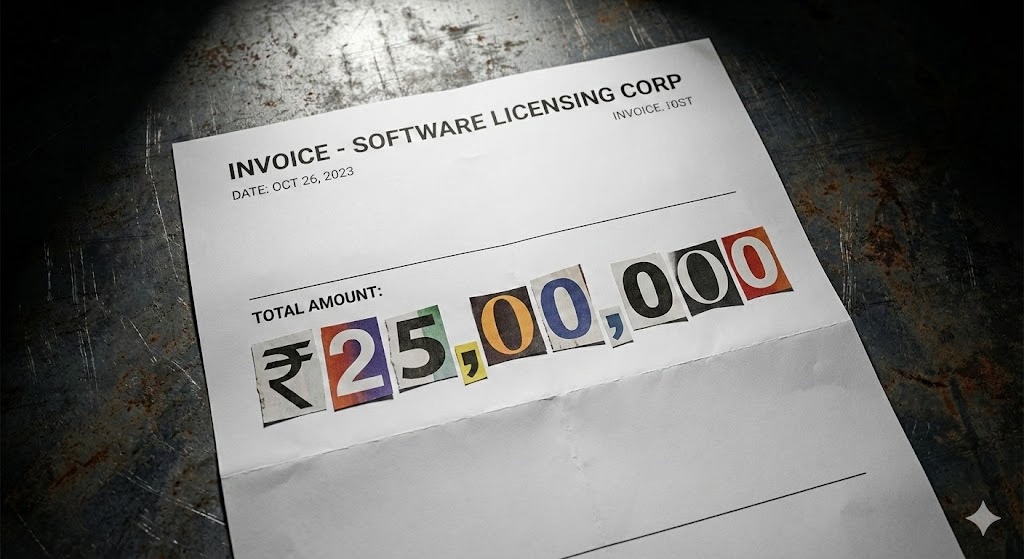
That realisation came from a quote that felt less like a price tag and more like a ransom note.
Mid-2025. I needed to digitize the rest of my security operations. I went back to the same vendor who built our payroll system. Their product works. I trusted them.
The quote for the full ERP was: Rs 25 lakhs upfront, Rs 15,000 per month for cloud hosting, and Rs 3.5 lakhs per year for support starting in year two.
I ran the numbers. Even stretching the cost over ten years — generous for any software life cycle — ownership worked out to roughly Rs 70,000 per month. For a low-margin manpower business, that is not a petty cash item. It is a permanent fixed cost.
But the number was not the stop signal.
The Hidden Tax: Being the Guinea Pig
During the sales call, I asked one due-diligence question: how many others are using the full ERP suite?
There was a pause. Then the answer: most customers only use the payroll module. Very few buy the full ERP.
That changed the nature of the deal. Their payroll software has 500-plus paying customers. It is battle-tested. Their ERP is a ghost town.
If I bought the system, I would not just be a customer. I would be a beta tester paying enterprise prices to find edge cases nobody else had stress-tested. That is not a partnership. That is paying them to finish the product.
The Lock-In Math Nobody Shows You
Then I looked at the trend line. When we first bought the payroll software, the annual support fee was Rs 15,000. Today it is Rs 35,000.
Nothing fundamental changed in the software. Their power over us did.
Once employee records, tax history, and compliance data are locked into a system, leaving is painful. Vendors understand this. Pricing follows power. If I moved all operations — attendance, shifts, invoicing, client data — into their ERP, that power multiplies by a factor that cannot be negotiated away. What stops the Rs 3.5 lakh support fee from becoming Rs 5 lakhs in 2027? What stops the hosting charges from creeping up? Nothing. At that point I was not buying software. I was trading control for convenience.
When the Equation Changed
A few years ago, building custom software would have been financially irresponsible for a business my size. It would have required an agency or a full-time CTO — both risky bets.
By end of 2022, the equation had shifted. AI had made coding possible for people who are not professional developers. I had already built internal tools and coded my entire company website using AI. Coding was no longer the barrier. Time was.
I estimated I could build what I needed over four to seven months, using AI coding tools like Claude Code, Gemini CLI, Cursor, and Codex, with infrastructure capped at Rs 4,000 per month, and direct feedback from the people actually using the system.
That did not make building easy. It made it possible.
The Actual Decision
Buying software hides risk: future price hikes, dependence on roadmaps you do not control, and being a small account inside a large vendor’s database. Building introduces different risks. AI is not a magic wand. It introduces bugs, security problems, maintenance overhead, and personal time cost.
But there is a difference that matters. When you build, you own the failure modes. When you buy, you inherit someone else’s incentives. If a system I build breaks, I fix it. If a vendor system breaks, I wait.
In my business, waiting is the bigger risk. So I chose to own it.