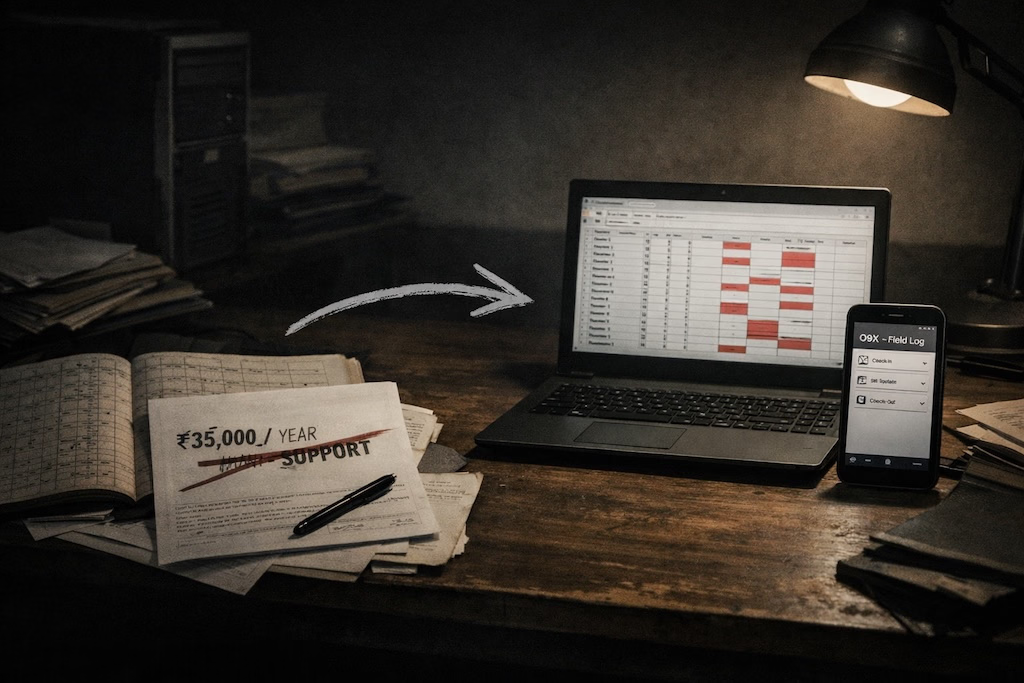
I am building O9X on a hard infrastructure ceiling of Rs 4,000 per month. It will bridge field operations to accounting without replacing either side. This is the first log.
The Gap That Payroll Software Does Not Cover
In a manpower services business, payroll and invoicing solve the visible problems. Salaries go out on time, invoices get raised, the business looks stable from the outside.
We had that covered. We used Zoho Books for accounting and a proprietary payroll system we paid Rs 3 lakhs to license. Both handled their designated job. Neither handled what happened between the field and the ledger.
Customer complaints became routine as we scaled. Small issues. Repeated issues. My ops team could not resolve them without a ritual: check WhatsApp threads, open Excel trackers, call field supervisors, reconstruct events from memory. There was no single source of truth — only people, partial records, and competing interpretations. No immediate financial loss, but the setup would collapse under higher volume. Payroll systems do not fail loudly. Operations do.
Two Experiments, Two Dead Ends
Before building, I tested two off-the-shelf options.
First, Airtable. We automated site-visit notifications to customers. Deployment was fast and customers responded well to the transparency. Then the system became brittle. One process change required reworking multiple automations, often pulling in additional paid tools. Costs scaled faster than value. Airtable works for small internal workflows; it cannot anchor core operations at scale.
Second, ERPNext. It covers more ground than Airtable and runs on open-source. I hired external developers to customise it for Indian manpower operations. That was the failure point. No outside team understood the business well enough to build for it. Explaining the business to developers cost more time and money than building the system myself. ERPNext is capable; customising it for a niche service business is not worth the spend.
The Legacy Cost
While both experiments failed, the existing payroll software created its own drag. We paid Rs 3 lakhs to license it. We pay Rs 35,000 every year for mandatory support. It runs offline, on a single desktop. Moving it to the cloud would add Rs 50,000 per year.
My largest cost centre — payroll — sits on one machine. If that desktop goes down, operations go blind. Zoho Books runs in the cloud and reduced dependence on specific individuals. The payroll system does the opposite: it concentrates risk in one location, one device, one person who knows where the files are.
The Build Decision
Three options were on the table. Airtable was too fragile at scale. ERPNext was too rigid to customise. The legacy payroll software carried Rs 35,000 in annual support cost and a single point of failure.
I chose a fourth path: build O9X on mature open-source tools with a hard cap of Rs 4,000 per month in infrastructure spend. The design is not to replace Zoho Books or eliminate the payroll system in one move. The design is to connect what currently has no connection — field data to payroll engine to accounting output.
The Integration Plan
Phase 1 establishes field truth. The immediate problem is disputed operational data: attendance, shifts, and site visits reconstructed from memory instead of recorded at source. O9X will capture these on mobile, at the point of occurrence. No Excel trackers. No WhatsApp screenshots as evidence.
Phase 2 kills the legacy dependency. Once field data is stable, payroll logic moves into O9X. I will run it in parallel with the existing payroll system for one month. If the numbers match, the legacy system goes — along with its offline risk and its Rs 35,000 annual support fee.
Phase 3 connects to Zoho. O9X will not touch the balance sheet. Clean invoices and payroll entries will flow into Zoho Books via API. Zoho handles the accounting layer. O9X handles everything that happens before the accounting entry exists.
What This Series Documents
O9X is an internal operations system for a low-margin, high-volume service business. It is not a SaaS product. It is not for sale.
This series documents the build: the stack, the schema, the failures, and the rewrites. Each log records what shipped, what broke, and what changed in the design as a result.