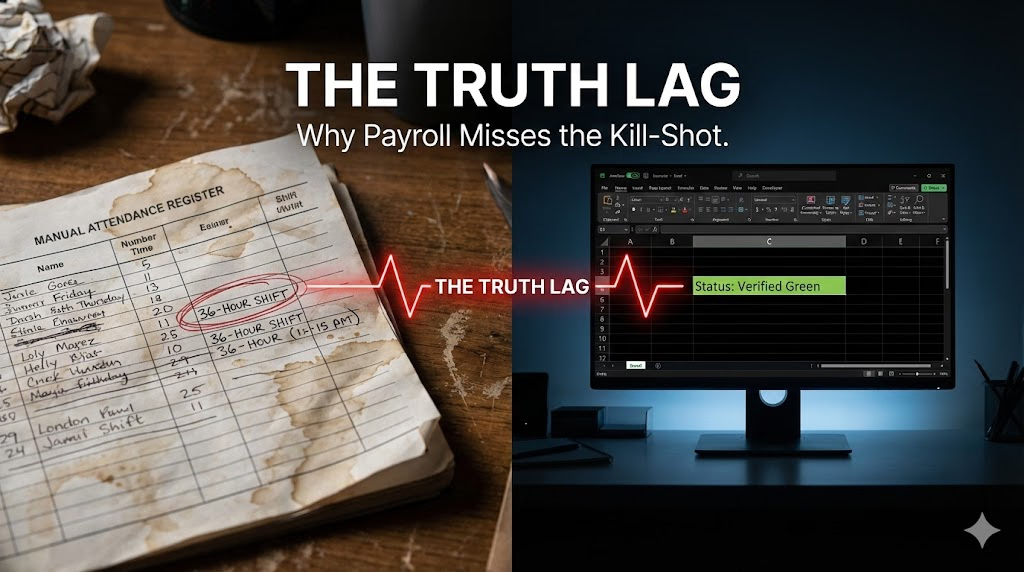
 A customer flagged that one guard at a specific unit had worked 36-hour shifts more than six times in a single month.
This violates our internal safety rules. It violates basic labour laws. On paper, it was impossible — our system caps extended shifts.
But it happened. And I did not know.
At the time, nothing looked broken. Attendance arrived daily. Manpower coverage showed green. The daily WhatsApp updates said “No issues.” My ops staff had learned how to pass the rule checks without technically breaking them. Not maliciously — just enough flexibility to manage the chaos of the field.
The system could not stop such violations. It could only report them later.
When the System Speaks Too Late
In my business, these problems surface monthly during payroll processing.
My payroll team flags excess hours. Not as a blocker, but as a post-facto alert. By then, the shifts were done. The guard was exhausted. The risk had already been created.
That was not enforcement. It was bookkeeping.
Every month, the same ritual followed. HR and accounts pulled a list of violations. Field ops were called for explanations. I reviewed the exceptions list. Ops staff were told it should not repeat. Everyone agreed. Everyone moved on.
The count kept falling month by month, but it never hit zero. Four to five cases slipped through every month.
That number matters. In the security business, a 10% failure rate does not kill you. One incident is enough to break trust.
The Reconstruction Tax
The business was living in two versions of reality at once.
Version A, from daily reports: WhatsApp updates saying all clear. Version B, from month-end paperwork: signed attendance sheets showing repeated rule breaches.
To reconcile the two, we relied on memory, explanations, and retroactive justification. No one was lying with certainty. No one was right with certainty. Every month, hours went into figuring out what actually happened 30 days ago.
That is the Reconstruction Tax: energy spent not on running the business, but on establishing what version of events was true.
Why Financial Numbers Did Not Save Us
The financial data looked clean. Payroll was correct — we paid for the extra hours. Invoices were raised and most customers paid without dispute. Salaries went out on time and the guard was happy for the extra pay.
Financial systems only care after the fact. They assume the underlying truth is sound. They do not enforce behaviour; they summarise outcomes.
By the time we noticed a violation, it was already weeks old. Sometimes the customer had already noticed. Sometimes they had not.
Most customers ignored it. That made it worse.
Ignored problems do not disappear. They accumulate silently until a larger client, an auditor, or a guard pulls the thread.
The Risk Equation
This was not about a few thousand rupees in overtime. It was about credibility at scale.
Large customers do not forgive patterns. Labour law does not forgive repetition. A single guard complaint about forced overtime can trigger penalties exceeding Rs 50,000 per incident.
More importantly, I recognised something uncomfortable: I was running a business where truth was discovered late, not enforced early.
That is not an operations problem. That is a control failure.
The Constraint
Operations do not fail when calculations are wrong. They fail when violations stay invisible long enough to feel normal.
That was the moment I knew O9X could not be a digital timesheet.
Attendance could not be a monthly artefact or a WhatsApp update. It had to be real-time, enforceable, and strict. Not to look modern. To stay alive.